Every November, bright orange marigolds dance along decorated ofrendas, accompanied by colorful papel picado, while homes and streets fill with the sweet, fresh smell of pan dulce. Día de los Muertos also known as Day of the Dead, is a cherished tradition celebrated throughout Latin America, and is strongly identified with Mexico. The tradition is about celebrating the lives of our passed loved one; those who have passed live on in our memories.
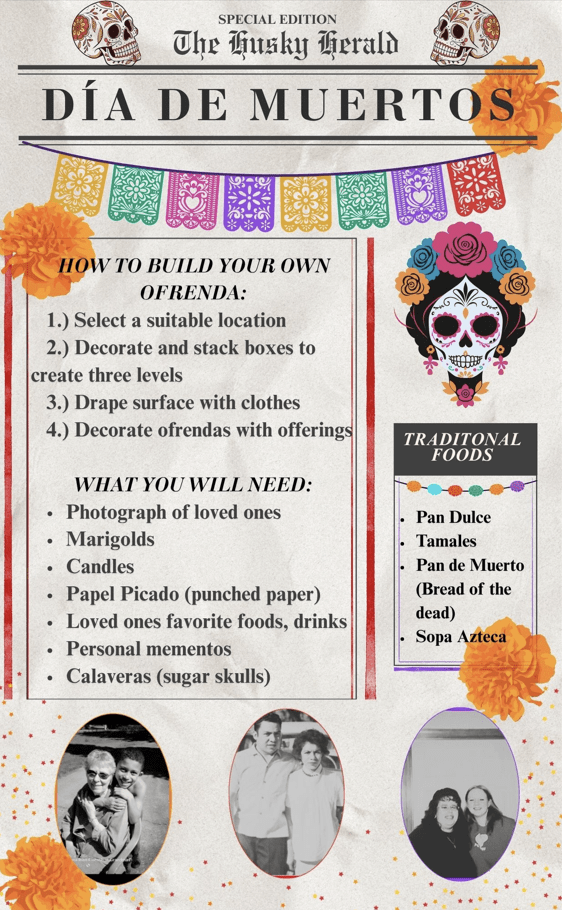
From Nov. 1 to Nov. 2, the spirits of passed loved ones are believed to cross over to the land of the living and spend time with their relatives for two days. This celebration is enjoyed throughout October every year. This sacred tradition is not a season for mourning, but to celebrate. One of the most important traditions in this holiday is building an ofrenda (altar) that represents the loved ones who have passed away. On an ofrenda, there are numerous decorations: papel picado, favorite foods like pan dulce or tamales, drinks, sugar skulls, marigolds, candles, personal mementos, and photographs of the ones who have passed. Ofrendas are usually built in homes, cemeteries, or public places. They are built with levels; the tops represent Heaven, the middle; Earth and the bottom representing the Underworld, as stated by Saint Joseph’s University. These ofrendas serve to honor the ones who have passed and give the families a place to celebrate those lives and share memories.
Marigolds have been important to this Mexican tradition because of their bright orange color and strong scent that are believed to help guide the dead one’s spirit home, according to The Mexican Musuem. Marigolds and their relationship with this holiday goes back thousands of years. It traces back to pre-Hispanics Aztec rituals which are connected to the goddess Mictecacihuatl, or the Lady of the Dead. As described by Desert Botanical Garden, “The story goes that Mictecacihuatl allowed spirits to travel back to earth to reconnect with their family members. The fragrance, which is a musky smell, from marigolds is said to lead souls from their burial place to their family homes. Throughout the years, this tradition adopted Roman Catholic aspects from Spaniards who conquered Mexico.” Now currently, these flowers still hold a significant meaning to the ancient tradition, decorating ofrendas where the orange color, fragrance, and memory intertwine.
Sugar skulls, also known as calaveras, stand as one of the most iconic symbols in this vibrant tradition, representing both sweetness and fragility. Mexican artist, José Guadalupe Posada’s is known for his famous illustration of Calavera Catrina, which is a female skeleton with a plumed hat. Calavera Catrina was originally known as a critique of the social influence of those who wanted to look more European instead of embracing their own Mexican heritage. Using the inspiration of Calavera Catrina, Guadalupe Posada, is one of the prime reasons for the success of today’s skull imagery. The Mexican Museum states how, “His illustrations were political satirizations of the Mexican society of his time, where the artist caricatured and exposed class habits through his skull drawings and etchings. After Posada’s death in 1913, his calaveras became a symbol for Día de Los Muertos.”
With the symbolism of the Catrina skeleton, people across Latin America like Mexico, Guatemala, El Salvador, Bolivia, Ecuador, Peru, Nicaragua, and Venezuela have been known to do Catrina makeup and dress up like skeletons. This tradition is known to be an act of respect and to acknowledge that death is a natural part of life. Instead of fearing what comes naturally, it is about embracing. “It honors the memory of deceased family members and friends, as well as historical figures and ancestors. The intricate makeup serves as a tribute to their legacy.” Across these various Latin countries, festivals are hosted that welcome all ages who dress up in the Catrina inspired outfits. It provides a sense of community to the people and welcomes a universal experience which unites humanity. This practice is colorful and decorated with marigolds, bright colored outfits and makeup with the dangling papel picado around the streets. “Papel picado, which translates into “chopped” or “punched” paper, are beautiful banners made out of paper or plastic panels that are cut with intricate designs. These decorations can be used for virtually any celebration and are also frequently used as decorative home accents pieces.”
Here at UW Bothell, the president of the Latino Leadership Incentive, Alondra Guzman, this tradition is very meaningful and personal. “Every year, my family and I create an altar for my dad,” she shared. “We include pan dulce, a Coke bottle, some of his favorite candy, and a picture of him. Though tempting to eat, these offerings help us feel close to him and keep his memory alive.” Guzman also goes on to explain why it is important for her to keep these traditions alive with the hardships facing immigration in America currently, “Right now, when so much feels overwhelming. This celebration reminds me of our strength, resilience and the importance of storytelling. It also allows me to remember those who have been lost in immigration centers and other places of the world. Those lives remind us why family, safety, and community are so essential.” Alondra Guzman also goes on to explain, “I want people to know that anyone can celebrate Día de Muertos! There are actually different days that hold special meaning: October 27th is often for remembering lost pets, November 1st is dedicated to remembering children, and November 2nd is dedicated to remembering adults.”
It is important to recognize the vast cultures here at UW Bothell. For Alondra Guzman, “it’s important that UW Bothell students see Día de Muertos as a reflection of love and community. When we take time to recognize it, it reminds Latine students that our stories and traditions matter, especially when things can feel uncertain and heavy in our community. In these times, celebrating Día de Muertos creates space for connection, healing, and strength, which are all things our campus community can really benefit right now.” In a time where immigration is controversial, it is important to remember the human stories behind the headlines, the students, workers, and families who shape our community and country. Celebrating various traditions and cultures on campus is an opportunity to support those communities, understand new perspectives, and gain knowledge on traditions that shape our shared UW husky experience.
Latino Leadership Incentive (LLI) is a program to support Latine students on campus. With the local support of Latino Education and Training Institution (LETI). Currently, applications are open for students who are interested in joining. According to Alondra Guzman this year LLI has a lot in store for this university year, “We hope to attend and support the Student Association for Immigrants & Refugees at their upcoming Día de Muertos event. Within our LLI cohort, we’ll be hosting three events, that will include our 2nd annual Latine Culture Night in the spring, so keep an eye out for that! We’re currently recruiting new members. If anyone’s interested in leadership, culture, or civic engagement, apply!” This program is a great opportunity for communal support, expressing issues in the Latinx community and to engage with a variety of cultures surrounding Latin America. To learn more or apply one can go to their website: https://www.uwb.edu/connected-learning/student-cohorts/latino-leadership
Día de Muertos is a significant holiday for those who celebrate. For Alondra Guzman, it is about the remembrance of her father. For me personally, it is about the remembrance of my dear friend Ajay Houston, my grandfather, my Aunt Kim, and my Uncle Freddy. Anyone can celebrate Dia de Muertos regardless of culture. We can all learn and understand the natural nature that comes with life – death. It is about remembering that our loved ones live in our hearts and memories. The holiday reminds us how precious, and the fragility life holds. Día de Muertos shows how love transcends loss. So, whether you celebrate this year by building an ofrenda, simply take a second to remember, go to a local Día de Muertos celebration or simply share stories of those loved ones, it is something we can all find meaning in.
 The Husky Herald