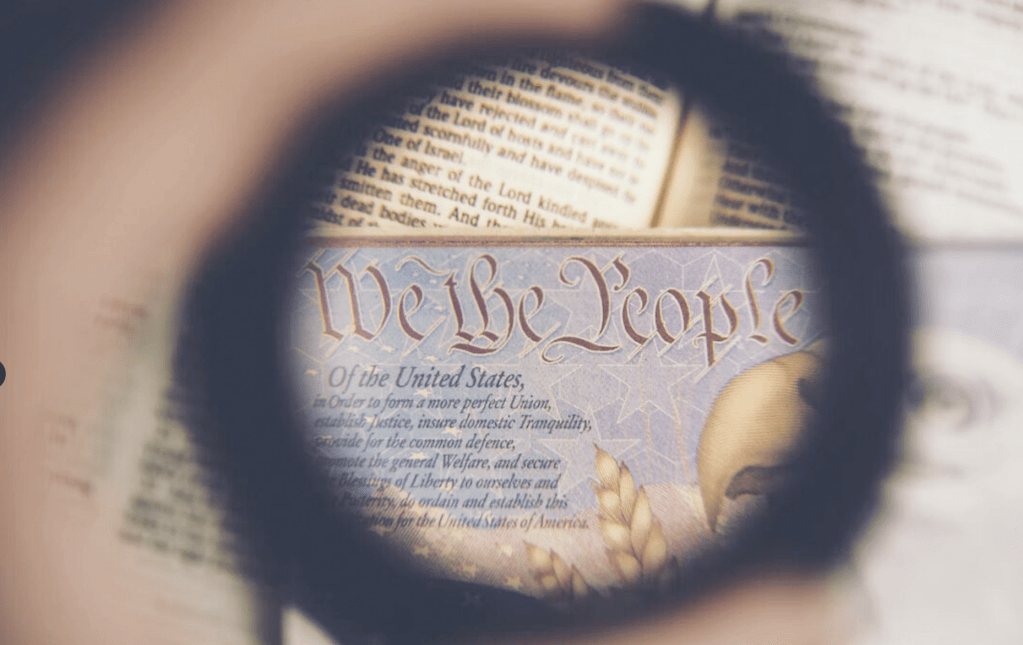
Whether the American flag is set on fire or a caricature of the country’s vice president is used as a reaction picture on the internet, both instances are directly protected by America’s Supreme Law of the Land. The five fundamental freedoms provided in the First Amendment of the U.S. Constitution — Speech, religion, press, assembly, and petition — are a significant part of what makes America the self-proclaimed free country that most people are familiar with. Free Speech, which allows individuals to express their opinions without fear of government retaliation, is incredibly foundational to democracy.
According to USA Today, it is not always easy to hear words that oppose personal beliefs, yet America cannot truly be a free society without the ability to exchange ideas. Free speech empowers the people, ensuring that those elected to power remain accountable and avoid corruption. The First Amendment has significantly benefited marginalized communities, primarily through journalism and social media. Raising awareness about social issues has played a significant role in the country’s social progress. However, free speech has also fallen at risk, particularly with the rise in censorship attempts and major national events since President Trump took office again in January 2025. To protect democracy, it is vital to understand that free speech cannot truly be free if the people are silenced.
The First Amendment and the right to free speech are far deeper than the right to speak freely; without it, a society where only particular perspectives dominate would emerge. Free speech enables activists and Non-Governmental Organizations (NGOs) to organize protests and raise awareness about social justice issues through handouts and social media. Teachers, professors, and other educators benefit from free speech by employing spaces for students to learn critical thinking and complex topics. American citizens are equipped with free speech, which enables them to express their religious or personal beliefs and engage in open discussions about issues that affect them. The open expression of ideas empowers citizens to criticize their government and request reform openly.
When the White House disallowed AP coverage of any events in the Oval Office after the news company refused to acknowledge the renaming of the Gulf of Mexico to the Gulf of America, the AP accused the administration of infringing on its First Amendment rights. According to the Reporters Committee for Freedom of the Press, the White House hoped that by barring the AP, reporters would ask friendlier questions and “gloss over unartful remarks.” The AP sued the White House in federal district court and the U.S. district judge, Trevor M. McFadden ruled that “[U]nder the First Amendment, if the Government opens its doors to some journalists — be it to the Oval Office, the East Room, or elsewhere — it cannot then shut those doors to other journalists because of their viewpoints.” Journalists depend on the freedom of the press to report on events, hold those in higher power accountable, and disseminate information to the public. Consequently, removing the AP’s right to report on Oval Office matters is viewed as a violation of the First Amendment.
By signing Executive Order 14149, a policy meant to restore free speech and end federal censorship, the Trump Administration paradoxically initiated a wave of censorship with significant repercussions to the American people. According to New York Times, Government websites were purged on over 8,000 web pages relating to diversity and LGBTQ+ information, climate research, and health information. In particular, the Centers for Disease Control and Prevention lost around 3,000 pages about HIV/AIDS, Alzheimer’s, overdose prevention, COVID, and vaccines. The 300 pages covering information for low-income children and their families were also taken down. These web pages came down after an order from Trump to remove anything involving what he claimed as “gender ideology” or words such as “inclusion” and “transgender.”. Anything that opposed the president’s views was removed. According to CBS News, health officials were barred from using pronouns in their emails and were forced to remove gender mentions from their websites to continue receiving funding. The removal of crucial information reveals an effort to silence and erase marginalized groups already at the receiving end of hate speech. The restriction of what should be public information stifles discourse, a major part of a functioning democracy.
On top of the scrubbing of federal websites, the Trump administration began attacking the Smithsonian museum with an initiative to review the exhibits to fit Trump’s view on American history before the nation’s 250th birthday. In a report done by Politico, White House spokesman Davis Ingle stated that the Trump administration was “committed to rooting out Woke and divisive ideology in our government and institutions.” A letter from the White House to the Smithsonian threatened to cut the museum’s funding if it failed to remove exhibitions that “degrade shared American values.” The current censorship efforts at the Smithsonian have sparked fear that many other museums could also fall victim. Furthermore, this is a broader attempt at controlling the perspective on American history. The pressure on these historical institutions to conform to specific ideologies hinders the exchange of free ideas and the museum’s right to educate the public. The Smithsonian’s censorship poses a threat to the democratic principle that all voices deserve to be heard, undermining the diversity of thought that allows the government to derive its power from the people.
In recent times, social media has acted as a double-edged sword for free speech and democracy. For one, platforms have enabled more globalized engagement and collaboration, resulting in a diverse range of opinions and easier access to information. It has made activism easier, allowing more people to speak out against injustice and to come together to develop solutions. Movements often mobilize communities to lead societal changes and hold politicians accountable. Yet, it has also given rise to arguments between the left and the right’s views on “cancel culture,” hate speech, and misinformation. While some online believe cancel culture is necessary, others see it as an infringement on free speech, a debate that has sparked mass division online. The same platforms that can empower people and enable societal progress can also give rise to conflict. Ultimately, society has always grappled with complex issues and power struggles, making it increasingly necessary to foster literacy skills and environments where diverse opinions can coexist.
 The Husky Herald