
Written by: Alice Chu, Ian Craig, Pun Desai, CJ Jones, Sandie Del Rosario; affiliation to HH
Behind UW Bothell’s programs, departments, student clubs, and staffing levels sits a metric-based budgeting system that dictates how money moves across campus. As one of three University of Washington campuses, UW Bothell utilizes a model known as Responsibility Center Management, or RCM. The framework relies entirely on revenue generated from student tuition alongside state and federal grants.
According to Segan Jobe, associate vice chancellor of finance and business services, the portion of the budget funded by tuition is divided into two categories: academic operations and administrative operations. Jobe defines academic costs as direct funding for teaching and learning, including faculty compensation and classroom supplies. Conversely, administrative costs cover institutional overhead, including non-instructional staff, building leases, utilities, and office supplies. Within this tuition-funded budget, about 70% is allocated toward academic operations while 30% goes to administration.
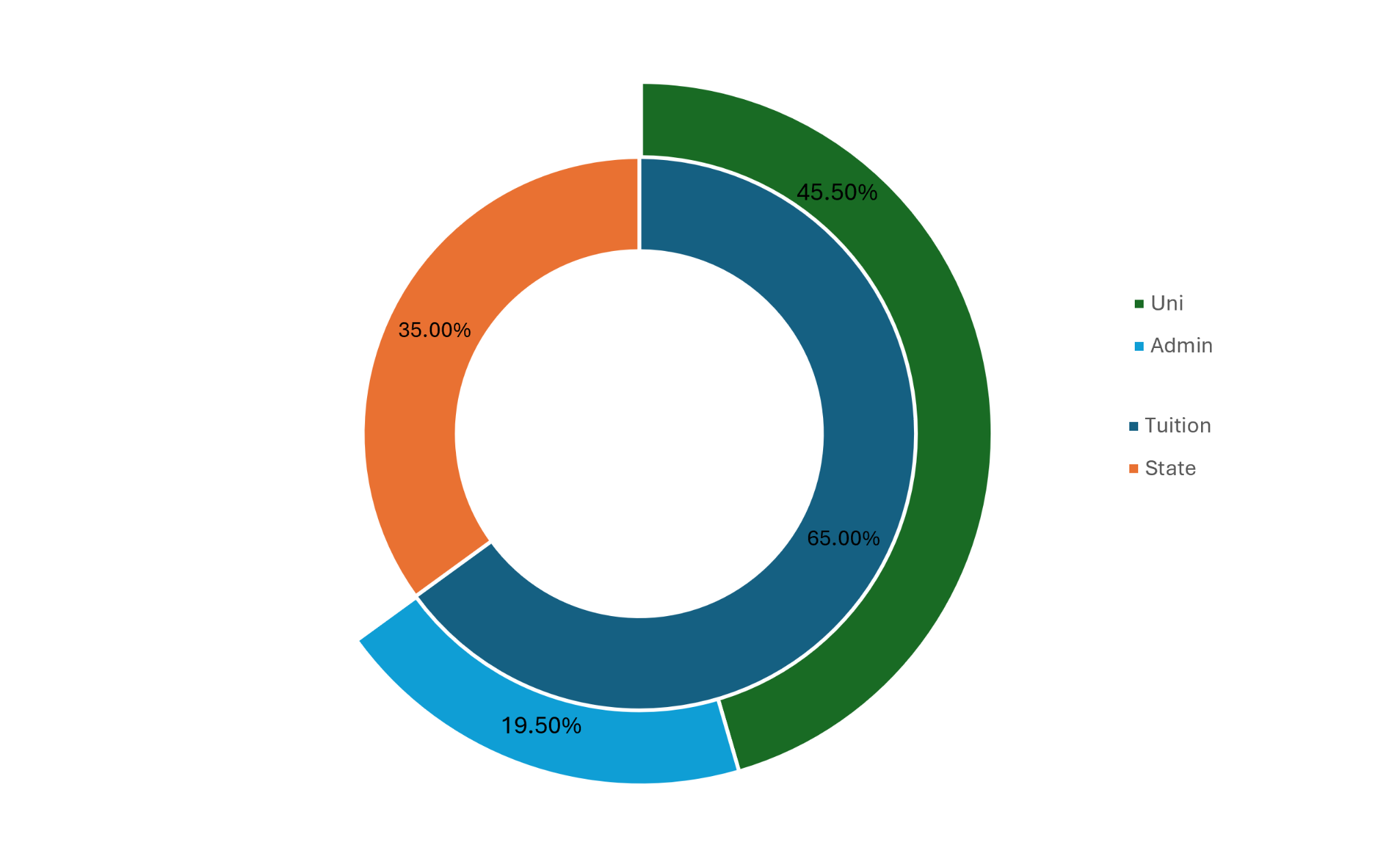
Tuition revenue accounts for 65% of the total operating budget, while the remaining 35% stems from state funding. State fund allocation varies by circumstance. Typically, the state designates most of these funds for administrative purposes and routes the remainder to academic operations.
According to the fiscal year 2023 University of Washington Economic Contribution Impact Report, federal funding for sponsored research programs and grants has steadily increased since the passage of the American Recovery and Reinvestment Act of 2009. The university also receives significant capital from non-federal sources, including foundations, nonprofits, industry, state and local governments.
The Trump administration’s proposed budget would reduce the Department of Education’s funding by roughly 15%, dropping it from $78.7 billion to $66.7 billion. In a federal lawsuit challenging this cap, filed by Washington and 21 other states, the University of Washington stated the institution stands to lose $90 million to $110 million, Cascade PBS reported. This policy shift represents a nearly 3-to-1 reduction in the ratio of infrastructure cost coverage, causing an estimated 73% drop in the specific funding category that legal filings state would lead to staff layoffs and postponed medical research.
The Responsibility Center Management model allocates funding to campus schools based on a metric called Full- Time Equivalent. This enrollment figure weights a school’s funding by combining its total number of declared majors with the credits taught in its courses. Consequently, funding scales directly with enrollment rather than academic discipline. While science, technology, engineering, and mathematics schools inherently require high-cost laboratory spaces, the funding model does not automatically favor them at the expense of other programs, Associate Vice Chancellor Segan Jobe said.
However, this enrollment-dependent model creates a stark disparity for the School of Interdisciplinary Arts and Sciences. Despite requiring specialized media labs and production studios to support its digital arts curriculum, the school has historically lacked specialized facilities, a gap administrators are attempting to close with a new media studio scheduled to open in fall 2026.
In legal filings, the state of Washington and co-plaintiffs argued that the proposed spending caps would reduce clinical trials for chronic diseases, cancer and addiction. While a federal judge granted a preliminary injunction temporarily halting the overhead restrictions, university officials say long-term research funding remains uncertain.
According to university budget documents, calculating the 65% tuition-funded portion against the internal institutional splits reveals the net allocation of the total operating campus budget. Based on these figures, 19.5% of the total budget goes toward administration, while 45.5 % is allocated to academic operations. This structure sets the stage for personnel costs, which represent the largest expense within classroom operations. “Most of it is going to pay the salaries of the staff and the faculty who work here,” said Keith Nitta, an interdisciplinary arts and sciences professor. Compensation alone for faculty and staff members makes up 85% of academic funds. This is 38.88% of the total budget.
(Data Vis)

Academic funding levels directly dictate a university’s classroom environment and student-to-faculty ratios. For example, private institutions like Seattle University utilize higher tuition rates to maintain smaller course caps. Seattle University charges an in-state tuition of $57,825 to support an 11-to-1 student-to-faculty ratio, according to data from the College Board. In contrast, the University of Washington system operates with a base in-state tuition of $12,260 and a broader 20-to-1 systemwide ratio.
However, these systemwide averages mask stark structural differences between campuses. While the UW Seattle campus relies on massive undergraduate lecture halls balanced by small graduate seminars, UW Bothell historically used low student-to-faculty ratios as a primary recruiting tool. Under the enrollment-driven demands of the Responsibility Center Management model, UW Bothell administrators face mounting pressure to expand class sizes, introducing high-cap courses of 60 to 90 students alongside smaller, specialized seminars.
According to Department of Education and University of Washington Office of Federal Relations summaries, the Trump administration’s May 2, 2025, budget request proposed a 15% discretionary funding cut to wind down the federal agency and defund low-income student resources. Although a government shutdown stalled the proposal, Congress ultimately used it as a baseline before restoring the budget on Feb. 3, 2026. Prior to that restoration, university officials warned the planned modifications threatened to severely destabilize financial support systems for first-generation and low-income students across the UW and UW Bothell campuses.
Although the proposal isn’t law, the presidential budget requests can signal policy priorities and can influence the stability of programs that universities depend on. Among the most significant proposed changes are the complete elimination of several federal programs aimed at supporting disadvantaged students and increasing college access.
One of the largest proposed eliminations targeted the TRIO programs. The U.S. Department of Education described TRIO as a collection of federally funded initiatives providing academic tutoring, financial aid guidance, mentoring and college preparation for students from low-income backgrounds or families where neither parent attended college. The administration’s budget request sought to eliminate all funding, arguing that states and universities should fund these services independently.
The budget proposal also eliminates the Gaining Early Awareness and Readiness for Undergraduate Programs (GEAR UP). The program works with middle schools and high schools in low-income areas to increase college awareness and preparation. The DOE illustrates GEAR UP funds tutoring, college visits, and advising
The Federal Student Aid office described Federal Work-Study as a program providing part-time, campus-based jobs to help students cover tuition and living costs while gaining professional experience. These positions commonly supported daily campus operations and provided vital financial assistance to students who otherwise struggled to afford college. By shifting financial responsibility away from the federal government and toward states and institutions, the proposed budget reduced federal involvement in programs designed to expand higher education access for low-income, first-generation and underrepresented student groups.

As federal funding decreases, universities often rely more heavily on tuition revenue to offset budget deficits. At UW Bothell, tuition already constitutes a major portion of the operating budget. According to the university website, international students represent approximately 4% of the overall campus population, but they pay significantly higher tuition rates. While an in-state undergraduate pays a base tuition of $12,260, international undergraduate students pay $43,017 annually. This higher rate means international enrollment contributes a disproportionately large percentage of tuition revenue, particularly within specific fields like business and STEM, where international enrollment historically reached 12% to 16%.
This shift aligns with broader political rhetoric and shifting immigration policies under the Trump administration, which may be influencing macro enrollment trends. Rather than isolated campus contractions, the data reflects national patterns. The Institute of International Education reported that the U.S. saw a 7% decline in new international student enrollment during the 2024-25 academic year. The shortfall marked the first drop in new foreign enrollments since the COVID-19 lockdown during the 2020-21 academic year.
When Congress officially rejected the administration’s spending reductions on Feb. 3, the final appropriations bill restored the agency’s baseline budget and added a 0.4% increase, bringing total discretionary spending to $79.1 billion. The legislative reversal ended months of campus anxiety following the initial White House proposal to slash $12 billion from federal education funding. However, university officials face a constantly moving target as the Trump administration shifts its strategy toward dissolving the Department of Education entirely. According to a report by Education Week, the administration’s restructuring plan aims to transfer key federal student aid and loan functions to other agencies, such as the Department of the Treasury, creating ongoing uncertainty for institutional research programs and financial aid stability.
Student resources may be the area hit hardest by changes to federal allocations. Ron Krabill, a professor in the School of Interdisciplinary Arts and Sciences, warned that a contraction in federal support will force immediate institutional shifts that compromise student resources. “One of my biggest concerns is the cuts to student funding for student scholarships,” Krabill said. “And that the reduction in Pell Grants and the reduction in other kinds of funding for student scholarships is going to hit our student body hard.”
Roughly 31% of the campus undergraduate population relies on federal Pell Grants to subsidize tuition costs.
Students and faculty at UW Bothell took action in response to threats by the Trump administration. Students marched on campus with signs to protest the presence of the Immigration and Customs Enforcement agency on March 11. Participants chanted “Keep ICE Out!” in the pouring rain at the noon rally. Organizers handed out care packages containing whistles, instructional safety guides and copies of Fourth and Fifth Amendment rights. The demonstration marked the second coordinated campus walkout this semester, following an earlier march through the university maker’s fair.

The Husky Herald/Ian Craig :A student protestor at the UWB Plaza with a “Keep ICE Out!” sign during a Mar 11 march.

The Husky Herald /Ian Craig : A care package distributed to students at the Mar 11 protest at UW Bothell, consisting of a whistle and a “Know Your Rights” card which outlines how to respond if approached by Immigration and Customs Enforcement agents.
At events like these, students are responding to policy changes that directly alter their educational environment. Higher education officials are now tracking the active push to dissolve the Department of Education entirely. Under this plan, core functions would be dismantled or moved to separate agencies like the Department of the Treasury. For campuses reliant on centralized civil rights protections and financial aid pipelines, this reorganization points toward continued instability.










Leave a Reply