
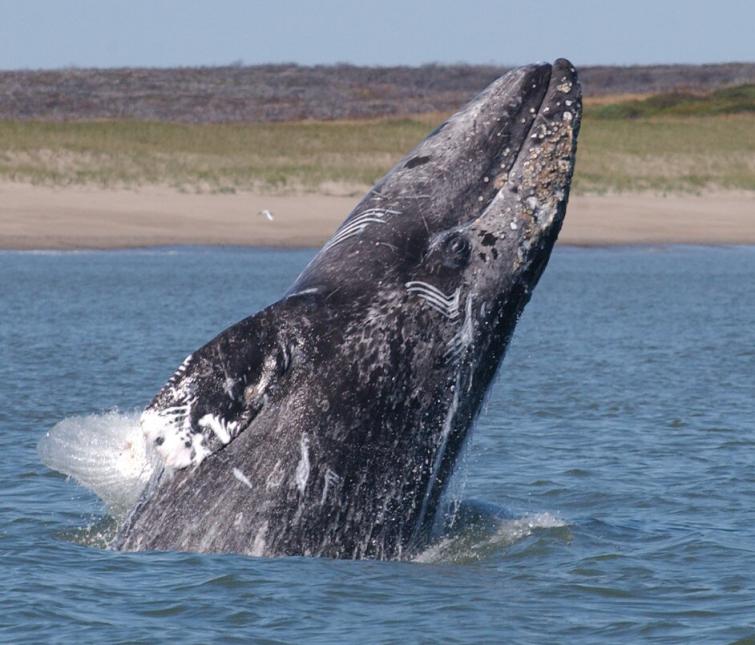
This year, 30 dead Gray Whales have been found in Washington State, the second highest number of strandings recorded in Washington.
Gray Whales, like many species, migrate seasonally. However, with changes to the ocean ecosystem due to increased human activity and rapid climate change, migration patterns are interrupted and sometimes even altered. The majority of the Gray Whales found dead in Washington showed signs of malnutrition, according to the Cascardia Research Collective. Many of them also suffered blunt force trauma, most likely from boat collisions which scientists presume happened due to straying from usual routes either to find alternative sources of food, or navigational difficulties from malnutrition.
Gray Whales partake in one of the longest migration routes of mammals, making them particularly vulnerable to ocean changes accelerated by climate change. They travel northbound in the spring to feed in the Arctic after spending winter breeding in Mexico. In summer they feed in the Arctic to build fat reserves, then spend the next 6-8 months essentially fasting while traveling southbound and raising their calves in Mexico. The diet of gray whales consists of amphipods; small creatures found at the bottom of the seafloor. The recent Unusual Mortality Event (UME) reveals a disturbing pattern of the destruction of the ocean ecosystem as populations of amphipods die out due to melting ice brought on by climate change. This loss of habitat for smaller ocean creatures creates a rippling effect across the entire ocean as bigger animals like Gray Whales rely on them to survive.
The main population that can be sighted in Washington during March to May are the Eastern Pacific Gray Whales migrating up to the Arctic in the spring. The population recovered from the brink of extinction due to whaling and peaked in 2016 with about 26,000 individuals. However, after that, there was a slow decline and an UME in 2019-2023 during a marine heat wave. According to NOAA, in 2025 the population had reached half of what it was just a decade ago in 2015, with no signs of recovery.
Due to the decline in Arctic food supplies, a small group of Gray Whales take a detour to stay in Washington for longer before migrating north. They are called the Sounder whale population and have steadily grown in numbers, coinciding with UME timelines. Research by the Cascadia Research Collective show better health conditions for this group as they feed on abundant Ghost Shrimp in the Puget Sound in a unique adaption strategy.
Currently the Eastern Pacific Gray Whales are not listed as a federally endangered species. With the recent UME, their population is listed as high exposure to climate change. Under the Washington Department of Fish and Wildlife (WDFW) they are identified as a priority species.
Migration is a right of all species. This right is threatened by increased human activity, especially as climate change imposes a compounding effect. The Convention of Migratory Species (CMS) “is the global treaty of the United Nations that addresses the conservation and effective management of migratory species and their habitats.” Under the State of World’s Migratory Species report, they found that overall, about 20% of CMS-listed species are threatened with extinction and almost half, 44%, have a decreasing population trend. For marine mammals, 30% are faced with threats of extinction. The highest concern was that CMS-listed fish species, as almost all, roughly 97%, were faced with threats of extinction. As climate change continues, migratory species face higher risks as they rely on a larger span of habitat to survive.
If you happen to spot a stranded marine animal, report it to the West Coast Marine Mammal Stranding Hotline at 1-866-767-6114. Moreover, if the creature is a whale, contact the Cascadia Research Collective at 360-791-9555.












Leave a Reply