
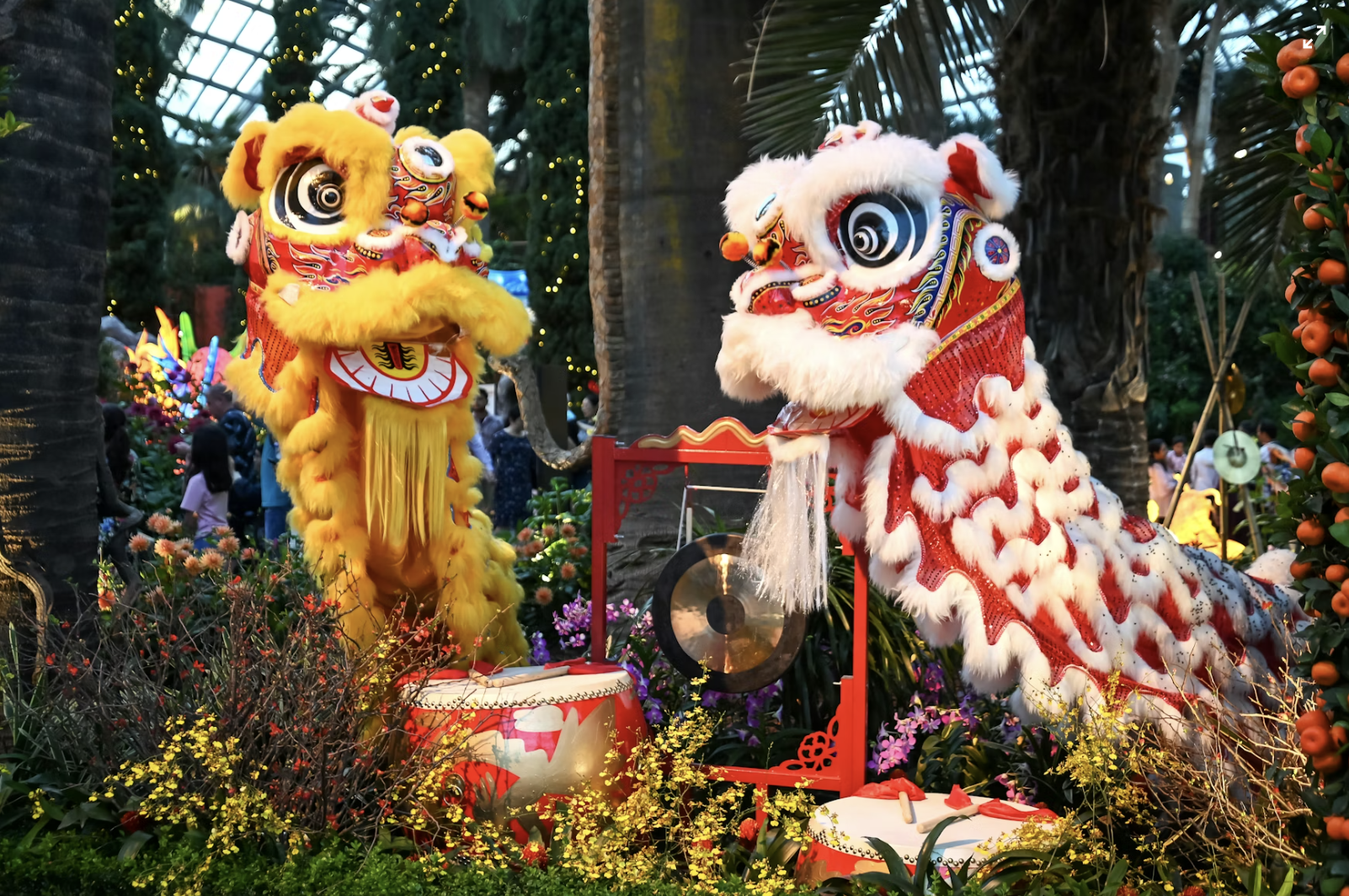
During cold month of January, red lanterns decorate streets in China with dancing lions and dragons promenading through the crowds. Red envelopes filled with money (hongbao) are given to children, as a symbol of luck. Fireworks will be filling up the night sky as Lunar New Year rolls in on Feb. 17, 2026, the Year of the Fire Horse representing freedom and boldness.
Chinese New Year is traced back to the Shang Dynasty over 3,500 years ago, however it does not have an exact beginning date. During the Shang Dynasty it was known to make sacrificial ceremonies to honor their gods and ancestors at the beginning of the year. The original story of how Lunar New Year began has numerous variations and myths. The most well-known legend includes a mythical beast named Nian. This beast was known to eat livestock, crop and individuals on New Year’s Eve, according to Timothy S. Y. Lam Museum of Anthropology. avoid the Nian beast attacking the villagers; people would put food on their doorstep to feed the beast hunger.
A wise old man figured out the beast’s weakness: loud noise and the color red. From then on, red lanterns would be in people’s households, accompanied by red scrolls in the village’s windows. Back then, people loudly cracked and broke bamboo sticks to scare off to scare off the furious beast.
The Chinese calendar follows the Lunisolar Calander which means the dates are determined by the skies, the moon (lunar) and sun (solar). Each month begins when the new moon is not visible in the night sky. This means the new year starts at the moon’s mid-point, which takes place any time between Jan. 21 and Feb. 20, according to National Geographic.
Each year, an element and an animal are associated with the new year. This came to be from The Great Race. For the year 2026 it will be the year of the Fire Horse with fire representing the element, and the horse representing the Chinese zodiac. The Fire Horse is a symbol of freedom and dynamism. The fire represents boldness, change, intensity, and the horse symbolizes action, speed, leadership, and innovation. Horses are very important in Chinese culture because they are known as the backbone of ancient Chinese civilization. Used for transportation, agriculture and military; horses became cultural symbols signifying power, endurance, aspiration and nobility.
Lunar New Year represents numerous traditions, values and cultural practices that bring people together in various Southeast Asian countries. To UW Bothell alumni, sisters, Xiya and Siqi Zheng, it represents something very personal. “Lunar New Year has always meant family, togetherness, and renewal to me. Growing up as a Chinese immigrant, it was a time centered around being with loved ones, sharing meals, and honoring traditions that connect generations in my family. While attending UW Bothell, Lunar New Year remained a grounding moment for me. Balancing school and jobs with family celebrations helped me appreciate how important it is to stay connected to my cultural roots, even while navigating a busy college environment,” stated Xiya Zheng.
Having all cultures represented is important at UW Bothell. This creates an inclusive environment where students can feel seen and heard. While China is the founder of Lunar New Year, other countries such as South Korea, Vietnam, Singapore, Malaysia, Taiwan, Hong Kong, the Philippines, and Thailand, among others, celebrate this renowned holiday. For many students from different cultural backgrounds, having this celebration on campus can go a long way. Looking back, Siqi Zheng reminisces how, “Seeing Lunar New Year acknowledged on campus meant a lot. Recognition validated a part of my identity that often exists outside academic spaces. It made me feel that my culture was respected and welcomed, and it helped create a stronger sense of belonging as a Chinese immigrant student.”
It is important for the community here at UWB to feel included and welcomed. UW Bothell alumni mention how as Chinese immigrants, to see their culture represented and respected was significant. However, there are improvements that students can make for one another to make representation more prominent on campus. Xiya Zheng mentions, “small acts from friends or classmates could have made Lunar New Year feel more meaningful and inclusive. Simple things like acknowledging the holiday, asking about my traditions, or showing curiosity about what Lunar New Year means to me would have gone a long way.” Siqi Zheng reinforces this concept, adding, “Peers showing curiosity and respect or asking about the holiday, learning its meaning, or simply wishing someone a happy Lunar New Year would have gone a long way.”
As previously mentioned by the alumni, one way to make people feel included during this Spring Festival is to greet people. It is a profound tradition during the new year to spread goodwill and cheer for your community and neighbors. Another way to celebrate is to wear red as this is known to bring prosperity and luck in the new year, according to CNN. remove bad luck from one’s home, the article mentions Jan. 28 is the day reserved to clean. This is to remove the bad luck from the previous year. It is strongly discouraged to clean on the first day of the new year because it would sweep away the incoming good fortune. It also mentions not breaking anything, not being angry, and spending time with loved ones are all ways to bring all the good fortune into the new year.
With no featured Lunar New Year events or festivities being hosted at UW Bothell this year, there are still student associations students can get involved with if they want to feel more connected to one’s culture and community. The following are some Asian student associations here on campus: Chinese Student Association, Filipino American Student Association, First generations Club, International Student Society Club, Korean Student Association, Vietnamese Student Association, South Asian Student Association and Southeast Asian Student Association.
If UW Bothell does not offer enough events, students are welcome to attend student association activities at UW Seattle or UW Tacoma campuses.
With the year coming to an end, we can start to inspire the changes that Siqi and Xiya Zheng suggested; to uplift one another and being curious about our neighbors. UWB was originally founded to be a commuter university, but that does not mean we can’t create more of an inclusive culture here on campus which fosters innovation and understanding one another. One can begin by greeting a person in your class, joining events on campus and being celebratory of one another’s differences. The Husky Herald welcomes a year guided by the fire’s intensity, the horse’s spirit of freedom and change, the luck carried in red, and the promise of prosperity for all!
Happy Lunar New Year!







Leave a Reply