
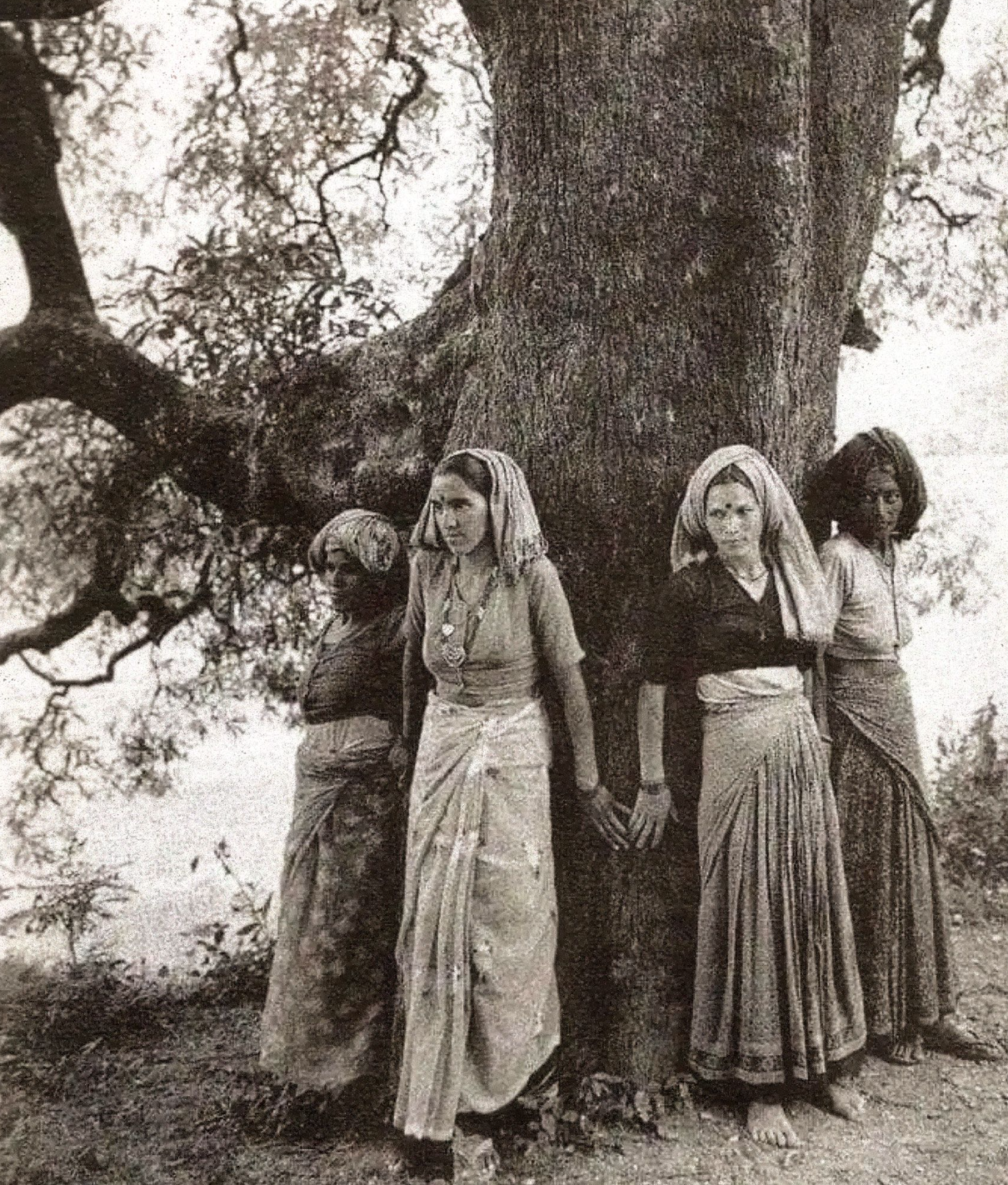
Photograph by Pamela Singh, “Chipko Tree Huggers of the Himalayas”, 1994
The food you eat, the clothes you wear, and technology you use all have one thing in common; the majority of them were produced on a different side of the planet. These industries are continuously targeted for their unsustainable practices driving climate change; however, rarely do we look at the human costs.
Oftentimes, it is the countries and people that contribute the least to climate change that end up facing disproportionate effects. This is explained by the phenomenon of geographic luck, a concept popularized by Jared Diamond explaining how success of nations is dependent on environmental factors like location and resources available. The connection between neo-colonialism and climate change becomes apparent as we witness the trends of consumer nations extracting resources in unsustainable and unethical practices from countries facing serious climate disasters. Similarly, we can take a closer look at who is impacted by the majority of the violence, and resource limitations caused by the climate issue. As Women’s History Month comes to an end, and Earth Month begins, we should take a moment to reflect on the ties between women, climate, land stewardship, and resource management.
Unsustainable practices don’t just have an environmental cost — they also have a human cost, and it impacts women the most. According to the United Nations University Center for Policy Research, 75% of garment workers are women working in perilous conditions for unlivable wages. In agriculture, women produce 60-80% of the food, however, despite being 50% of all workers, they make up less than 20% of land owners.
Climate change is not defined by an exponentially growing line on a graph. It has very real implications for communities around the world. While many of us might be unaffected on a radical level on a day-to-day basis, it is not a privilege everyone enjoys.
Climate change is considered a risk multiplier, meaning it exasperates the ongoing societal issues and inequalities. It increases workloads for women reducing their access to education and income. Women already work about 12 hours more per week than men in many developing countries, this number is expected to go up. In communities without running water, responsibility of collecting water falls upon women and girls. According to the Potsdam Institute for Climate Impact Research, women in parts of Ethiopia walk up to 110 minutes daily to collect water. It is expected to take up to 30% more time by 2050 due to climate change and water scarcity.
Less food availability due to drought and flooding in agricultural communities disproportionately affects women. A study done by University of Michigan found that women in Indonesia born in years with low rainfall were on average shorter, worse in health and less educated compared to women born in wetter years. This difference was not noted in boys showing gendered preferential treatment in resource allocation for young kids in times of resource limitations.
Environmental disaster and climate adaptation plans need to work to prioritize women. According to the UN, 80% of people displacement caused by climate change are women. During climate disasters, women and girls face increased risk of sexual violence, trafficking, and child marriage. In environmental catastrophes, women are 14 times more likely to die.
Wangari Maathai, founder of the Green Belt Movement, encapsulates this idea perfectly, “In Kenya women are the first victims of environmental degradation… They have begun to appreciate that they, rather than their government, ought to be the custodians of the environment.”
This concept of eco-feminism explores how stewarding land through a patriarchal lens has led to exploitation of the land which in turn hurts women disproportionately. The philosophy is living out through her work, The Green Belt Movement. Maathai leads the environmental organization in Kenya to empower communities, specifically rural women by conserving the environment through creating opportunities for sustainable livelihoods. It started to combat deforestation and rural poverty. Over the course of their work, over 51 million trees were planted, and hundreds of thousands of women were employed, providing income and education to women who didn’t previously have access. Maathai was the first African woman to win the Nobel Prize for her work.
Women have always been at the forefront of environmental protection movements. Long before the term environmentalist was coined, Amrita Devi Bishnoi in Jodhpur, India, inspired her townspeople to act and protect an ecologically and culturally significant Khejri tree species, from being cut down in the 1730s. It is recorded that as royal guards approached with axes, she ran up to guard the tree by hugging it. She and many of her townspeople were killed by royal guards before the decision was overturned. Similarly, in the 1970s, Chipko women-led forest conservation movement in rural India where people formed physical barriers to prevent deforestation. Another well-known example of similar types of activism is Julia Butterfly Hill, who spent over two years living in a tent on a thousand-year-old Redwood in California to prevent it from being cut down. These examples throughout time all reveal a successful type of environmental activism led by women.
As per the words of author Rosemary Radford Ruether, continuing to assess the climate change issue impacting us worldwide “demands that we must speak of eco-justice, and not simply of domination of the earth as though that happened unrelated to social domination.” The U.S. is one of the countries contributing the most to climate change, while being least at risk. One of the most impactful individual actions is being mindful of our consumption practices, especially regarding food, clothes and technology. Acknowledging the people and women most vulnerable to the climate crisis forces us to put a face to the victims of our everyday choices.









Leave a Reply