
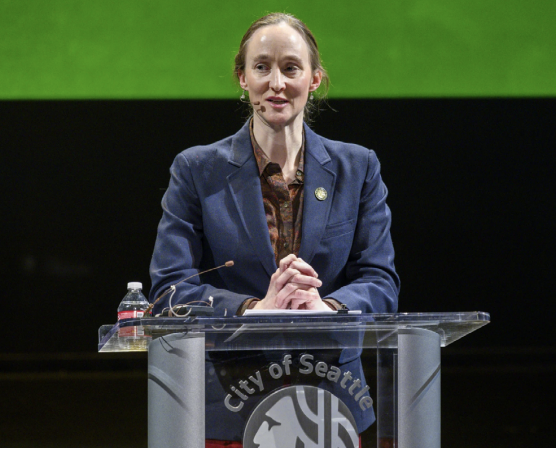
Image Credit: KNKX
On Nov. 2, 2015, former Seattle Mayor Ed Murray declared a state of emergency on homelessness as the current public health crisis. It has been a decade since the city declared the state of emergency, and Mayor Katie Wilson is taking a different approach this year. In February, Mayor Wilson signed Executive Order 2026-02 to accelerate the city’s efforts to help unhoused residents. The executive order will focus on accelerating shelter expansion and investing in interventions that have proven successful over time.
Mayor Wilson’s plan aims to reduce unsheltered homelessness, improve safety and well-being for the affected people and communities. The plan will expand shelter capacity by 960 beds (540 in development + 420 additional) and serve 1,750 people annually. Of the 540 beds in development, 344 were added through City-funded projects. Another 196 came from expediting projects underway that other sources or regional partners funded. This leaves a total of eight new shelters scheduled to open in 2027.
According to the executive summary of the plan, the cost of this shelter investment will total approximately $37 million in 2027. Funding will come from two sources: $19 million in existing and reallocated funds, and an additional $18 million allocated to the Seattle Human Services Department. The mayor’s 2027-2028 budget proposal released on October 13 includes a more detailed overview of where and how this plan will be funded.
Several shelters have already opened this year, including Bayside Enhanced Shelter, Brighton Village, and Belmont Village. The city plans to open a few more by the end of the year, including Cloverleaf Village and Glassyard Commons, a Purpose Dignity Action (PDA) operated shelter. It will also expand existing shelters.
The plan covers four shelter types: essential, enhanced, enriched and complex. Essential shelters provide overnight shelter, limited services and are often client operated. Enhanced shelters provide shelter for longer and have case management to support future housing navigation. Enriched shelters provide housing navigation, case management and service connections to meet people’s needs. Complex shelters provide the same as enriched and intensive case management with on-site services to meet specific needs for many individuals. Based on data collected on unhoused individuals, around 60% of people in Seattle would need either access to an enriched or complex shelter. As a result, this plan is to ensure that around 60% of the shelters this coming year use one of these models.
These new shelters will also include resources to help unhoused individuals get on a clear path. These resources include case management and housing navigation as well as programs with specialized behavioral health, medical care, substance-use treatment and legal services. Additionally, Mayor Wilson’s plan aims to aid residents who are at risk of homelessness, with the goal of helping 2,000 households stay housed.
A new online rental assistance application is also in development for 2027 to simplify access to help. The plan will also continue long-term rental subsidies and onsite services. The city and King County are working together with providers, people with lived experience and regional partners to establish the best resources that they can provide. With Mayor Wilson’s plan and the Seattle Housing Levy, which has been in place since 2023, there are all different kinds of forces at work to ensure we are addressing the crisis. Not to mention, these are just two of the many programs that are in place in the Seattle area.
According to the World Population Review, Washington’s homeless rate in 2024 was 40.0 per 10,000 citizens. This puts the state third in the country, with New York and California in second and first place, respectively. According to the executive order, ever since the city declared a civil emergency on homelessness, there has been a threefold increase in deaths annually of people presumed to be homeless.
Seattle has a long history with homelessness and housing crises. The Seattle Municipal Archives show a record of homelessness in Seattle, since it was first incorporated in 1869. The city jail has previously often served as shelter for those without a place to stay. The crisis of homelessness was especially noticeable during the Great Depression, when Hoovervilles were being built all over the country. The city ultimately decided to remove the shacks by burning them. Shortly before World War II, a shack elimination
program began. By 1942, the city reported it had burned about 600 shacks, with about 75 still scheduled to be destroyed.
While the city of Seattle has always faced a lack of housing, there have been many different strategies attempted by previous bureaucrats to resolve the matter. According to City Records, one of the most prominent policies has been the Seattle Housing Levy, initially passed in 1968. As the overview states, “For nearly 45 years, Seattle residents have consistently supported this critical resource.” Most recently, the levy was renewed in 2023, receiving a voter approval rate of over sixty-nine percent. The goals of this levy are to build over 3,100 new affordable homes, stabilize supportive housing workforce and provide direct assistance to prevent homelessness through housing stability services.
Since Mayor Wilson’s executive order was released, the plan has been reaching completion. The remainder of Wilson’s plan will be executed in 2027, making its future remain a mystery. The homeless shelters that have been established through this executive order are open to anyone, and resources are available by calling 211 for Washington state residents.
At UW Bothell, there are several information and care teams students can contact if they are looking for aid. The CARE Team have a variety of different resources available for students in distress. Their mission is to allow faculty, staff, parents and students the ability to contact all support services within one location. You can find resources such as the Husky Pantry, the Counseling Center and Safe Campus. No matter what service you are looking for, there is a place that has it all. Whereas it can sometimes be a challenge to find the exact resources that you need, the CARE team’s website is set up comprehensively for you to find assistance. The UWB website has a list of many resources depending on the situation.
For additional information on these resources, please email safecampus@uw.edu or call 206-685-7233 to make a report.













Leave a Reply