
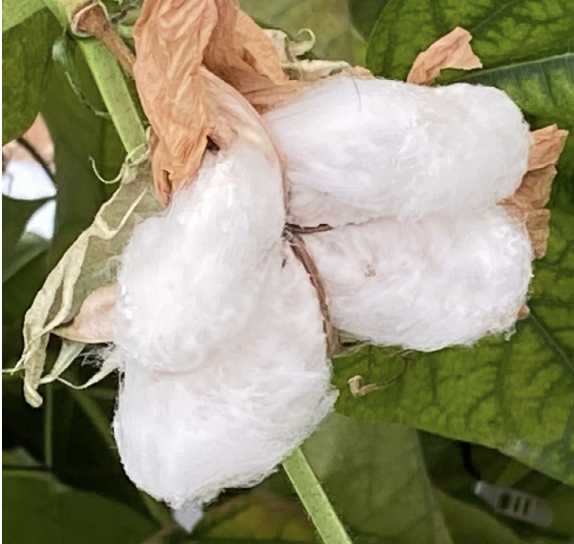
Image Credit: Magtech
An interview with David René Rodríguez, co-founder of MagTech, discussing their H&M collaboration.
Q: As co-founder, what inspired you behind the mission of MagTech?
A: The idea behind Magtech is to reconsider how we grow a material that is part of everyday life. People often think about cotton when they buy a T-shirt, but much less about the land, water and agricultural work behind it. Our mission is to develop a way of growing cotton without fertile soil, with greater control over water and plant nutrition. We want to connect agricultural research with products people actually use, while testing what it takes to make that approach practical at scale.
Q: What makes MagTech unique?
A: Our focus is on bringing hydroponics to cotton and developing the cultivation system around the crop. The plants grow with their roots in a shallow layer of water containing nutrients and dissolved oxygen. Drainage is collected, monitored, adjusted and recirculated, while water and nutrients consumed by the plants are replenished. We combine this with cameras, environmental sensors and AI-assisted analysis. We work with CEBAS-CSIC on crop management and with IRI, a joint CSIC-UPC institute, on
mechanization and robotics. Harvesting is currently assisted by suction equipment; robotic harvesting remains under development. The result is cotton grown by cotton plants, using a different cultivation method. The challenge is to make agronomy, engineering, fiber quality and production economics work together.
Q: How do you see MagTech changing the landscape of the fashion industry and what changes do you anticipate being made for textile agriculture?
A: Hydroponic cotton could give the textile industry an additional way to produce natural fiber in locations where fertile agricultural soil is limited. The ARKET garments show that cotton grown this way can move beyond a cultivation experiment and into a finished product.
Scaling requires much more than producing a good crop. We need to understand investment costs, energy demand, yields, labor
requirements and how consistently the system performs over time. Our aim is to complement existing cotton production. Farmers’ knowledge remains important, and any transition should include training and opportunities in crop management, nurseries, monitoring, maintenance and harvesting.
Q: What are your current thoughts on the future of fashion sustainability based on the conditions of the global market today? Do you apply your own thoughts or experiences to the work done at MagTech?
A: My view is that innovation has to make environmental and economic sense. A promising growing method will have limited impact if it cannot reliably deliver the quality and cost that the supply chain needs.
At Magtech, that means treating each pilot as an opportunity to measure and improve the system. Recirculating water is a design feature; the overall environmental benefit must be assessed across the full production process, including energy, nutrients, equipment and fiber output. Independent life-cycle assessment matters because no production method has zero impact.
For fashion more broadly, better raw materials need to be accompanied by durable products, responsible production and longer use. A new cotton-growing method can contribute to that work, but it cannot solve every challenge on its own.
Q: How did the collaboration with ARKET, H&M Group come about and are there any similar future partnerships with this group or others?
A: The ARKET launch grew out of development work between Magtech and H&M Group’s Circular Innovation Lab, bringing together cotton cultivation and the requirements of a fashion supply chain. ARKET, which is part of H&M Group, introduced garments made with this cotton in its fall 2026 collection. For us, that is a meaningful step from agricultural development to a product customers can wear.
We would like to build on that experience and explore further collaborations. I do not have additional partnerships to announce here; any future announcement would need to be coordinated with the organizations involved.
Q: How can students use this as a way to implement sustainability practices in their fields and careers?
A: Start by following an everyday product back to its raw materials and asking how it is made. A cotton T-shirt connects plant science, water management, engineering, design, business and consumer behavior.
Students can apply that perspective through practical projects: an engineering team could study monitoring or harvesting; business
students could compare production costs and adoption barriers; design students could investigate durability and material choices. Across all those fields, ask what the evidence shows, what the comparison is and what has been left out of the calculation.
My advice is to stay curious and work across disciplines. Useful sustainability work often starts with a specific, measurable problem and a team willing to test its assumptions.













Leave a Reply